
Kidney stones affect roughly one in ten Americans at some point in their lives, and the pain they cause–often described as among the worst a person can experience–tends to send patients into the healthcare system in a hurry. For stones that are small enough, they pass on their own with hydration and time. But stones that are too large to pass, are causing a blockage, or are associated with persistent infection require a procedure.
If your urologist has recommended surgery and you are comparing your options, this article will walk you through the most common minimally invasive kidney stone procedures, explain what Indiana patients pay at different types of facilities, and show you why WellBridge Surgical’s bundled pricing model represents a fundamentally different–and far more affordable–approach to care.
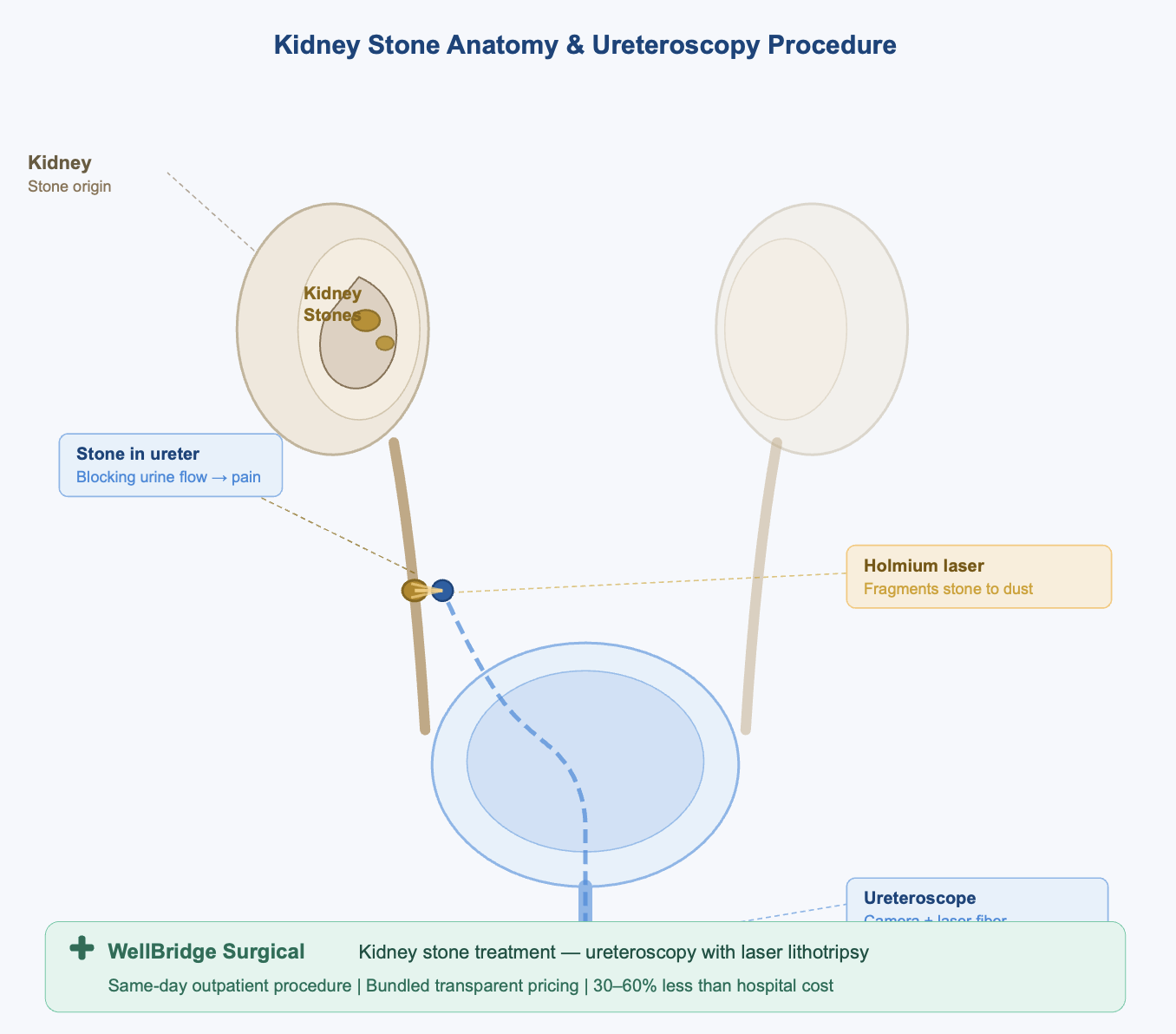
Urinary tract anatomy showing kidney stone location and ureteroscopy procedure pathway
The Most Common Surgical Kidney Stone Treatments
When watchful waiting is no longer appropriate, urologists typically choose from two well-established outpatient procedures:
Ureteroscopy with laser lithotripsy (URS): A thin, flexible ureteroscope is passed through the urethra and bladder into the ureter or kidney to reach the stone directly. A holmium laser then fragments the stone into small pieces or dust that can pass naturally or be removed. This approach is highly precise and effective for stones in the ureter or kidney that are too large to pass on their own. A small ureteral stent is often placed temporarily to ensure proper drainage while any inflammation resolves.
Shock wave lithotripsy (SWL): Focused sound waves are directed at the stone from outside the body, breaking it into smaller fragments without any incision. SWL is best suited for stones located in the kidney that are under 1.5 centimeters and have favorable characteristics on imaging.
Both procedures are performed on an outpatient basis, meaning you arrive, have your procedure under anesthesia, recover for a short period, and go home the same day. Neither requires an inpatient hospital stay when performed at an appropriately equipped facility.
What Kidney Stone Surgery Costs in Indiana
Indiana hospitals rank among the highest-cost facilities in the nation for surgical procedures, and kidney stone treatment is no exception. The variation in what patients pay depending on where they have their procedure can be dramatic. WellBridge can often save patients more than 50% of what hospitals charge, and 20%-40% of the expenses associated with other ASCs.
What the expense differential reveals is not just a cost difference but a structural variances in how care is delivered and billed. At a hospital, the facility, the urologist, the anesthesiologist, and the lab performing pre-operative blood work may each send a separate invoice. The timing and amounts of these bills can be difficult to predict before the procedure.
At WellBridge Surgical, there is one price covering everything. Before you schedule, you know exactly what you will pay–whether that is your WellBridge bundled rate or, for eligible employees on partner health plans, nothing at all.
Why Ambulatory Surgery Centers Deliver Superior Value
Ambulatory surgery centers like WellBridge Surgical are purpose-built for outpatient procedures. Their cost structure is fundamentally different from a hospital’s, and those savings are passed directly to patients and health plans.
Hospitals carry enormous overhead: emergency departments, inpatient wards, intensive care units, round-the-clock staffing, complex supply chains, and administrative bureaucracies. All of that overhead is embedded in the facility fee charged for every outpatient procedure, even relatively simple ones like kidney stone surgery.
An ambulatory surgery center eliminates most of that overhead. The facility is designed specifically for outpatient surgical care, the staff specializes in outpatient procedures, and the operational model is optimized around efficiency and patient experience rather than institutional complexity. The result is a procedure that costs a fraction of what a hospital charges–without any reduction in quality.
What to Expect at WellBridge Surgical
WellBridge Surgical’s urological team includes board-certified urologists with extensive experience in minimally invasive stone procedures. The center’s surgical suites are equipped with the latest ureteroscopy and laser lithotripsy technology, providing the same clinical capability available at major hospital centers in a more accessible and affordable environment.
On the day of your procedure, you will check in, complete pre-operative preparation (including IV placement and anesthesia administration), have your procedure, and spend approximately one to two hours in the recovery area before being discharged home with a family member or friend.
If a ureteral stent is placed, your urologist will schedule a brief follow-up procedure to remove it–typically within one to two weeks. This is a simple outpatient visit.
Recovery After Kidney Stone Surgery
Most patients recover from ureteroscopy quickly. Within 24 to 48 hours, you can expect to resume light activity. Urinary urgency, mild burning with urination, and blood-tinged urine are common and expected in the first few days. A ureteral stent, if placed, may cause discomfort until it is removed.
Most patients return to work within one to three days for desk jobs, and within one to two weeks for more physically demanding roles. Your urologist will provide specific instructions based on the complexity of your case and whether a stent was placed.
Follow-up imaging is typically recommended to confirm stone clearance and guide prevention strategies, since patients who have had one kidney stone have a significant likelihood of developing another over their lifetime.
Zero-Tier Options for Employer-Sponsored Plans
WellBridge Surgical partners with approximately 90 self-funded employers in Indiana to offer zero-tier pricing–an arrangement in which eligible employees who choose WellBridge for their procedure have their deductible waived entirely. For procedures like ureteroscopy, where the hospital cost can easily reach $20,000 or more, this translates into thousands of dollars saved by the employee and tens of thousands saved by the health plan.
If your employer is not currently a WellBridge partner, you can still benefit from transparent, bundled pricing that is typically 40 to 60 percent less than the hospital alternative. Contact WellBridge to confirm your options before your procedure is scheduled.
Healthcare can often feel intimidating and confusing concerning both pricing and treatment options. WellBridge Surgical remains committed to providing high-quality surgical services directly to patients with cost certainty, providing the peace of mind to proactively deal with preventative and corrective healthcare issues.
Visit our website at www.wellbridgesurgical.com to learn more about procedures and pricing, or call us at 317.480.4200.