
For women who experience abnormally heavy menstrual bleeding–a condition known as menorrhagia–the impact on daily life can be significant. Managing heavy periods often requires careful planning around activities, leads to fatigue from iron-deficiency anemia, and can substantially reduce quality of life. When medications and hormonal treatments have not provided adequate relief, endometrial ablation offers a highly effective minimally invasive solution.
If your gynecologist has recommended endometrial ablation and you are close to scheduling the procedure, this article will give you a clear picture of how it works, what it costs at Indiana hospitals versus ambulatory surgery centers, and why WellBridge Surgical’s approach to transparent pricing makes this procedure more accessible than many patients expect.
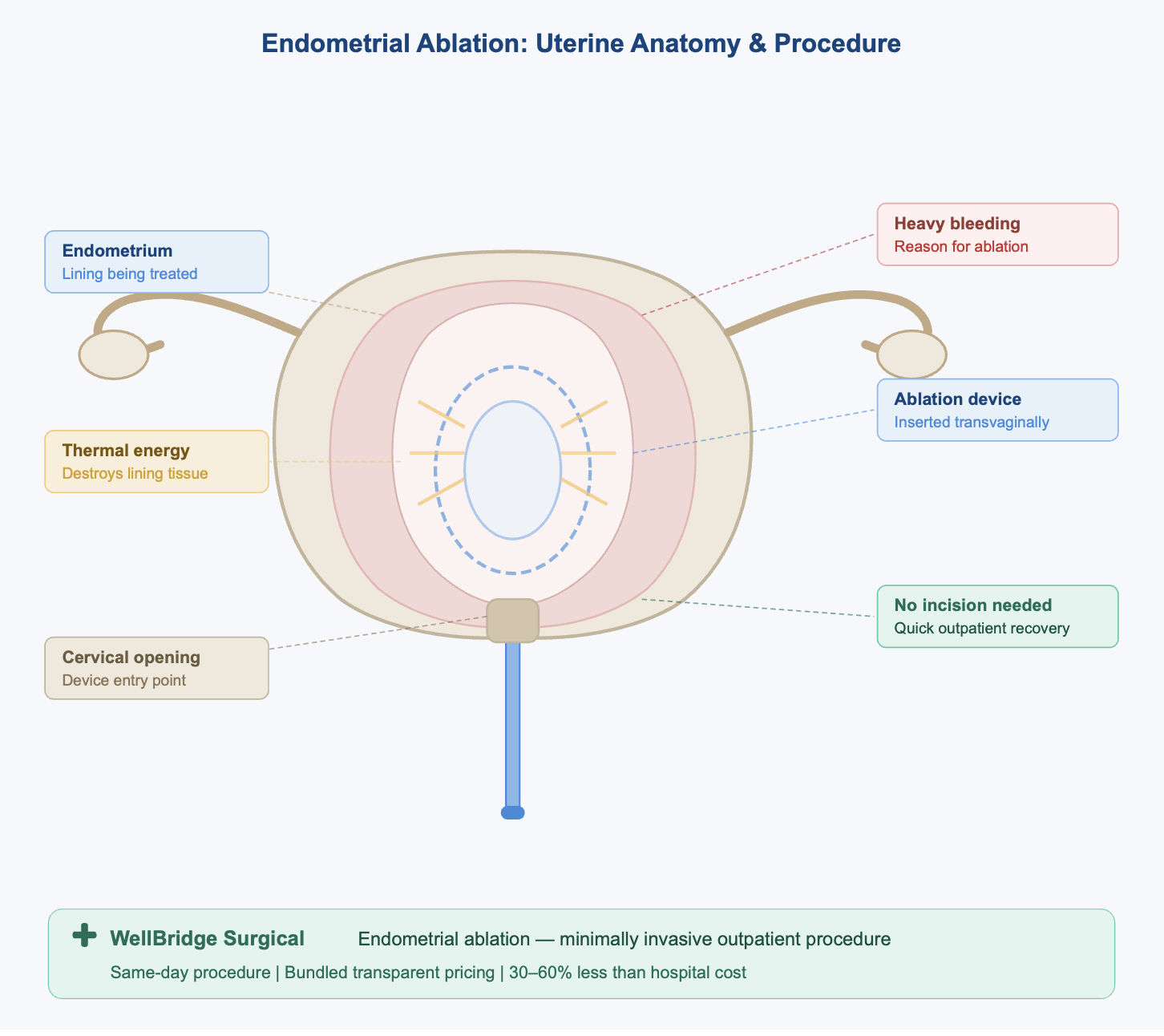
Uterine anatomy showing the endometrial lining targeted during ablation and the minimally invasive device used in the procedure
What Is Endometrial Ablation?
The endometrium is the inner lining of the uterus–the tissue that builds up and sheds during a menstrual cycle. In women with menorrhagia, this lining grows excessively or sheds abnormally heavily. Endometrial ablation destroys a thin layer of the endometrium using controlled energy, permanently reducing or eliminating menstrual bleeding in most patients.
The procedure is not performed vaginally with any incision. A slender instrument is passed through the cervical opening into the uterine cavity. Depending on the technology used, the endometrium is treated with thermal energy (heated fluid or a heated balloon), radiofrequency energy, microwave energy, or freezing. The entire in-office or outpatient procedure typically takes fewer than 30 minutes.
Endometrial ablation is not appropriate for women who wish to become pregnant in the future. It is intended for women who have completed childbearing. It is also not appropriate for women with certain uterine conditions, and your gynecologist will conduct a thorough evaluation before recommending it.
How Effective Is Endometrial Ablation?
The outcomes are among the strongest of any gynecological procedure for menorrhagia. Approximately 90 percent of women experience significantly reduced bleeding following ablation, and roughly half achieve amenorrhea–the complete cessation of periods. Patient satisfaction rates are consistently high.
For women who want to avoid the more significant recovery and permanence of a hysterectomy, ablation offers a compelling middle path: a brief outpatient procedure with a short recovery, lasting results, and preservation of the uterus.
What Does Endometrial Ablation Cost in Indiana?
As with most outpatient surgical procedures in Indiana, the cost varies dramatically depending on where the procedure is performed. WellBridge can often save patients more than 50% of what hospitals charge, and 20%-40% of the expenses associated with other ASCs.
As highlighted in a recent Becker’s ASC Review, and amplified via The Wall Street Journal, The Centers for Medicare and Medicaid Services (CMS) have supported physician recommendations toward ambulatory surgery centers (ASCs). As supported by WSJ in their commentary “Doctor’s Office Care at Hospital Prices,” Bobby Jindal and Charlie Katebi opined that Medicare has sometimes paid hospital-owned facilities two or three times as much as independent practices for the same service. They contend that this encourages hospital systems to acquire independent physician practices, allows hospital facility fees to be added even when care occurs away from the main hospital, and fuels consolidation to increase spending, insurance costs and patients’ cost-sharing. Needless to say, all of this makes pricing harder for patients to understand. Wellbridge simplifies all of this.
The key distinction, as with all WellBridge procedures, is what the WellBridge pricing includes. The WellBridge bundled rate covers the facility, the surgeon, anesthesia, and standard pre-operative requirements in a single fixed amount. At a hospital, each of these components is typically billed separately, and patients often do not see the full financial picture until well after the procedure.
High-deductible health plan patients are particularly exposed to hospital pricing. A patient with a $5,000 deductible who has a hospital-based ablation may find that her out-of-pocket responsibility equals or exceeds the total WellBridge price–and that assumes she can accurately predict the costs in advance, which hospital billing rarely allows.
The WellBridge Approach to Women’s Surgical Care
WellBridge Surgical’s gynecological team includes board-certified gynecologists with extensive experience in minimally invasive uterine procedures. The ambulatory surgery center environment provides significant advantages over a hospital setting for a procedure like endometrial ablation.
Focused, unhurried care. Ambulatory surgery centers are not managing emergency cases or competing scheduling demands. The result is a more predictable, efficient experience for patients.
Privacy and comfort. WellBridge’s surgical suites and recovery areas are designed for outpatient patients–not adapted from an inpatient hospital environment. The setting is calmer, more private, and more conducive to a comfortable recovery.
Experienced teams. The staff who assist with endometrial ablations at WellBridge do so regularly, with a level of procedural familiarity that contributes directly to safety and efficiency.
What to Expect on Procedure Day
Most endometrial ablation procedures at WellBridge are performed under light general anesthesia or monitored sedation, which ensures complete comfort throughout. Patients are asked to arrive approximately one hour before the procedure for pre-operative preparation.
The procedure itself typically takes 20 to 30 minutes. Patients then spend one to two hours in the recovery area before being discharged home with someone to drive. Mild cramping, similar to menstrual discomfort, is the most common post-operative symptom. A watery or slightly bloody discharge may occur for several days to a few weeks.
Most patients return to work and normal activities within one to two days. There are no incisions and no stitches to manage.
When Your Employer Has a WellBridge Partnership
WellBridge Surgical has established zero-tier pricing arrangements with approximately 90 self-funded employers in Indiana. Under these plans, employees who choose WellBridge for eligible procedures–including endometrial ablation–pay nothing out of pocket. The deductible is waived entirely.
For a procedure that can cost $10,000 to $18,000 at an Indiana hospital, this benefit is substantial. Even for patients not covered by a WellBridge employer partnership, the transparent bundled pricing delivers savings of 40 to 60 percent compared to a hospital setting.
Before you schedule, ask your provider for a complete all-in cost estimate. Then compare that number to what WellBridge publishes clearly on its website.
Healthcare can often feel intimidating and confusing concerning both pricing and treatment options. WellBridge Surgical remains committed to providing high-quality surgical services directly to patients with cost certainty, providing the peace of mind to proactively deal with preventative and corrective healthcare issues.
Visit our website at www.wellbridgesurgical.com to learn more about procedures and pricing, or call us at 317.480.4200.